
You Played Football. Now Your Kid Is Playing Flag. Here’s What You Need to Know.
If you grew up playing football and your kid just joined a flag league, you probably walked onto that field thinking you had a pretty good handle on what you were about to watch.
Then the game started and nothing looked quite right.
The field is smaller. There is no blocking. The quarterback just took a sack standing in his own backfield and nobody seemed that concerned about it. You are standing on the sideline with more questions than answers.
Here is what is actually different, and why most of it makes sense once you understand what the game is trying to do.
The Field Is Smaller Than You Think
A standard 5v5 flag football field runs about 70 yards long and 30 yards wide. No special teams. No kickoffs. Every possession starts on the offense’s own 5-yard line.
If you grew up on a 100-yard field with hash marks and a press box, this takes some getting used to. The game feels compressed. But watch it for a few minutes and you will realize the compression is the point. Fewer players, smaller field, everyone touches the ball. Your kid is not standing on the wing waiting for a play to come their way. They are in every single play.
There Is No Blocking
This is the one that gets former football players the most.
In 5v5 flag football, once the ball is snapped, there is no blocking. Receivers run their routes. The quarterback has to throw it. Defenders can go wherever they want.
Your instinct is going to be to tell your kid to pick up the blitzer or set a screen. That instinct is wrong here, and in most formats it is a penalty. Let it go.
The no-blocking rule is what makes the game work at this level. It keeps things safe, it keeps things moving, and it forces every player to learn how to get open instead of depending on someone else to create space for them. That skill translates directly back to the tackle game later on.
The Quarterback Cannot Run It Directly
The quarterback can scramble behind the line of scrimmage to buy time, but they cannot take the snap and run past the line of scrimmage themselves. What they can do is hand off to a teammate, then go out for a pass or receive a second handoff back. But straight quarterback keepers are not part of the game.
If your kid plays quarterback and they are a good athlete, this is going to frustrate them early. But it forces them to develop as a passer, go through reads, and make decisions with their arm. In the long run that is not a bad thing.
There Is a Pass Clock
NFL FLAG runs a 7-second pass clock. From the moment the ball is snapped, the quarterback has 7 seconds to release it or the play is dead.
Seven seconds sounds like plenty of time. Watch a few plays and you will see exactly why it exists. It prevents quarterbacks from holding the ball forever waiting for someone to get open. It creates urgency and forces kids to run cleaner routes and make faster decisions. Good habits either way.
One Rusher, From Seven Yards Back
One defender per play is allowed to rush the quarterback, but they have to be lined up at least 7 yards off the line of scrimmage before the snap.
This is where football dads start drawing up blitz packages on their phone at halftime. Save it. Teaching your rusher to get a clean release and take a good angle to the quarterback is more than enough at the youth level. The 7-yard rule exists to give the offense a fighting chance.
The No-Run Zone
Here is one most football parents do not know about until they see it called.
There are no-run zones on the field, located 5 yards before midfield and 5 yards before the end zone. When the ball is spotted inside those zones, the offense has to throw it. No running plays allowed.
It exists to prevent short-yardage power situations in tight spaces, which makes sense when there is no offensive line. If your kid is a running back, they are going to learn to be a receiver pretty quickly.
The Flags Are the Tackle
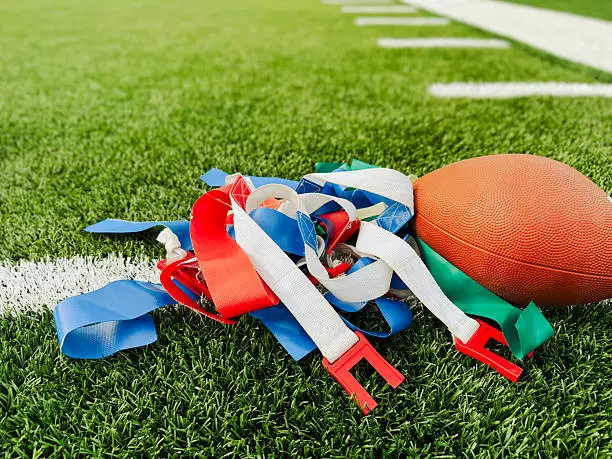
When a defender pulls a flag the play is dead. The spot is where the ball carrier’s feet were, not where the ball was.
Watch for flag guarding. Ball carriers cannot use their hand or arm to block access to their flags. It gets called more than you would expect and kids pick up the habit fast. Teach them early to keep their arms up and run through contact rather than protecting the flags. Protecting the flags is the thing that gets them flagged.
5v5 vs 7v7: The Short Version
Most youth leagues, especially anything connected to NFL FLAG, run 5v5. Five players per side, no blocking, 7-second clock.
Recreational adult leagues and older competitive youth leagues usually run 7v7. Seven players per side, more formations, limited blocking allowed near the line of scrimmage. The NFHS uses 7v7 for sanctioned high school play.
Worth knowing: the 2028 Olympics in Los Angeles will use 5v5. The format your kid is learning on a Saturday morning at the park is the same one that will eventually be on the biggest stage in sports. Not a bad detail to share with them.
What Carries Over From the Tackle Game
More than you think.
Route running is route running. A good out route works whether there are pads involved or not. Footwork matters. Reading a defense matters, maybe more in flag than in tackle because there is no blocking to bail anyone out.
Football IQ transfers completely. If your kid grew up watching games with you or just absorbing football from the couch on Sundays, that background shows up fast on the flag field. They will understand leverage, spacing, and tendencies in a way that kids without that exposure simply do not.
The mental side of the game is identical. Handling adversity, knowing your assignment, executing when the play breaks down. All of it carries over.
What You Have to Leave at the Gate
The physicality. The running quarterback. The idea that your biggest kid can just overpower people.
Flag football rewards skill, speed, and football IQ almost exclusively. The kid who outran everyone in tackle ball has to actually learn to play in flag. That is not a bad thing. It is a different challenge.
And if you are coaching, leave the ego at the gate too. Nobody is getting drafted based on their 8-year-old flag football season. Relax and let them play.
One Last Thing
There is something worth appreciating about what flag football does for kids who are just getting started. Growing up, there was no on-ramp. You showed up, put on pads, and figured it out fast or you got discouraged and quit. A lot of kids walked away from the game before they ever really got started because the entry point was too steep.
Flag changes that. It is tee ball for football. Kids get into the game earlier, with less fear, more touches, and a real chance to fall in love with it before things get complicated. By the time they put pads on, if they choose to, they already know what they are doing.
That is a good thing for the game.
— D.H.
